Nepal
The Eight Mountains: A NovelNepal is both a destination and a point of comparison in Pietro’s life: its inhabited valleys, working fields, and Himalayan routes renew his sense of what mountain life can be, while journeys there carry him into documentary work, humanitarian projects, and a wider understanding of his attachment to mountains. The country is not presented as a single landscape but through distinct encounters, from a village valley reached from Kathmandu to the arid plateau of Mustang and the approaches to Annapurna and Everest.
Landscapes and Mountain Life
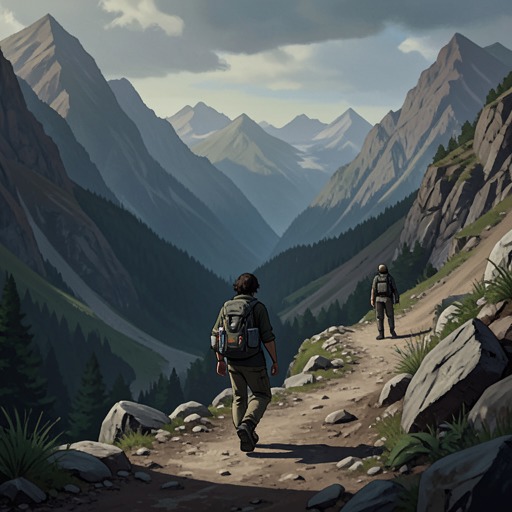
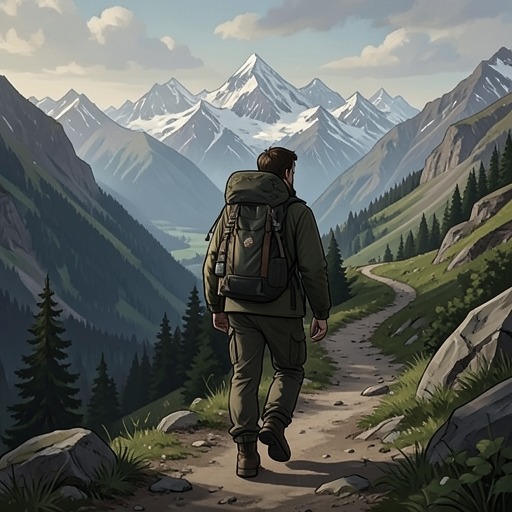
On Pietro’s first journey, Nepal feels like a journey back in time. A day’s drive from Kathmandu, and fewer than two hundred kilometres from its crowds, brings him to a narrow, irregular, wooded valley. A river can be heard below but not seen; villages sit higher on the slopes where sunlight softens the terrain. Mule tracks climb and descend between them, and narrow rope bridges cross streams that cut through the valley sides.
The inhabited slopes are shaped by cultivation. Terraces and rice paddies form semicircular steps edged with low dry-stone walls and divided into many smallholdings. In October, during the harvest, women kneel in the fields, men beat husks in the yards, and older women sift drying rice. Children help plough with oxen. Wooden ploughs, river stones used to sharpen scythes, and wicker porter baskets belong to a rural life that Pietro sees as still thriving. Trainers, radios, and televisions are present too, but they do not erase his impression that an older mountain civilization survives here. Along the route he sees no derelict buildings, a pointed contrast with the decline he associates with mountain communities at home.
Annapurna and the First Journey
Pietro travels up the valley towards Annapurna with four Italian mountaineers, sharing a tent with them for several weeks and bringing a film camera. The expedition is a paid assignment to make a documentary about mountaineering and observe how the group responds to extreme conditions. Yet as they near base camp, the surrounding life captivates him more than the project alone. He decides to remain after the expedition and make his own journey through the lower elevations.
Nepal’s material details also bring his earlier mountain life into view. The oxen and the children urging them recall Bruno’s yellow cane from the first time the two boys met. Pietro thinks Bruno would have liked Nepal: the comparison connects a distant landscape to a friendship rooted in another mountain village, without making the two places identical.
Work in Nepal
Later, while Pietro is in Nepal, he becomes involved with nongovernmental organizations. He films documentaries in villages where schools and hospitals are being built, agricultural projects and employment initiatives for women are being developed, and camps for Tibetan refugees are sometimes established. His experience is divided in its judgment. He dislikes the careerism and political manoeuvring he encounters among managers in Kathmandu, but in the mountains he meets people he regards as idealists, including volunteers, medical workers, students with Voluntary Service Overseas, and mountaineers who work as builders between expeditions. Their work is not free from ambition or power struggles, yet Pietro values being among people moved by idealism.
During this period he is in Mustang in June, on an arid plateau near Tibet, where small white houses cling to red rock. From there, a letter from his mother brings news about Lara’s pregnancy and her continuing work in the pasture and dairy business. The distance between Nepal and home is therefore crossed by family updates: Pietro is absent from Anita’s birth, but remains connected to events in the mountain household through his mother’s reports.
The Eight Mountains and a Return Call
In a valley below Everest, an elderly Nepalese man carrying a cage of live hens introduces Pietro to an idea that gives his travels a larger frame. The cage has a dozen separate compartments and is destined for a refuge where the hens will become food for tourists. Pietro has seen porters carrying chocolate, biscuits, powdered milk, and drinks along Nepal’s trails, but not a portable henhouse. After he asks permission to photograph it, the man poses beside the cage; their conversation turns to Pietro’s familiarity with the region and his interest in the Himalayas. Pietro explains that a mountain where he grew up fostered his desire to see the world’s most beautiful mountains. The man recognizes this as a tour of the eight mountains, linking the journey abroad to the mountain that first shaped Pietro’s attachment.
Nepal also becomes the place from which Pietro finally acts on news of Bruno’s collapse. After Bruno declares bankruptcy, closes the agricultural business, and is left alone while Lara goes to live with her parents and their child, Pietro reads his mother’s anxious message in Nepal. In Kathmandu, he leaves the computer and asks to use a telephone, calling Bruno from a booth. He has never made such a call from Nepal before. The answer comes only after several rings, but the call breaks the distance between them and begins Pietro’s return to a friendship he had long left unattended.